In 2026, LLMs like Grok, GPT-4o, Claude, and Llama 4 power everything from customer support bots to research assistants. But pure generative AI still hallucinates facts, works with outdated knowledge, and has no access to your private data. Retrieval-Augmented Generation (RAG) fixes all three by making retrieval a first-class architectural concern — not a workaround, but the standard pattern behind every production-grade AI application worth operating today.
Why Pure Generative AI Falls Short
Traditional LLMs are trained on a massive but static snapshot of data. Once training ends, four structural limitations kick in:
No real-time knowledge. The model’s world froze at its training cutoff. Ask it about something that happened last month and it either doesn’t know or — worse — confidently makes something up.
No access to private data. Your internal runbooks, Slack history, architecture decision records, and customer contracts weren’t in the training set. The model can’t retrieve them.
Hallucination. When an LLM doesn’t know something, it doesn’t say “I don’t know” — it generates a plausible-sounding answer. This is a feature of how transformers work, not a bug that gets patched away with a better model.
Context window limits. You can stuff documents into a prompt, but attention is expensive. Long documents get truncated or noisily summarized, losing critical details buried in the middle.
RAG addresses all four by giving the LLM a dynamic external memory it can query on demand.
What Is RAG?
The core idea in one sentence: retrieve relevant documents → augment the prompt with them → generate a grounded answer.
Introduced in the 2020 paper “Retrieval-Augmented Generation for Knowledge-Intensive NLP Tasks” by Lewis et al. (Facebook AI Research), the pattern has since become ubiquitous. Every major framework — LangChain, LlamaIndex, Haystack — and every major vector database — Pinecone, Weaviate, Qdrant, pgvector — treats RAG as the default workflow.
The key insight is simple: instead of hoping the model memorized the right fact during training, you find the fact at query time and hand it to the model as context. You turn a closed-book exam into an open-book exam.
How RAG Works: The Full Pipeline
RAG operates in two phases. Offline indexing runs once (and is updated incrementally). Online querying runs on every user request.
Phase 1 — Offline Indexing
Data ingestion. Pull from every source that holds knowledge your users need: PDFs, Confluence pages, Notion databases, Slack exports, Git repositories, SQL tables, REST APIs. Format conversion (HTML parsing, PDF extraction) happens here, alongside deduplication and access-control tagging.
Chunking. Raw documents are split into smaller pieces before embedding. This step is chronically underestimated. The chunking strategy shapes retrieval quality more than most people realize:
- Fixed-size splitting (every 512 tokens) is simple but crude — it breaks sentences mid-thought.
- Semantic chunking uses embeddings to detect topic boundaries, then splits there. Better relevance, more compute at index time.
- Hierarchical / parent-child chunking indexes small chunks for retrieval precision, but stores pointers back to the full parent section for generation context. This is the pattern used in most production systems today.
A 512–1,024 token chunk size with 10–20% overlap is a reasonable starting point. Overlap prevents information at chunk boundaries from falling into the gap between two chunks.
Embedding. Each chunk is converted to a high-dimensional dense vector by an embedding model. The vector captures semantic meaning, not keywords — so “account recovery” and “password reset” land near each other in vector space because the model has learned they refer to the same concept.
The embedding model is the most consequential single choice in your RAG stack. The same model must be used during both indexing and query time — mixing models breaks semantic similarity entirely.
Popular choices in 2026: OpenAI text-embedding-3-large (3,072 dimensions), Voyage AI voyage-3-large (strong on long documents), Snowflake-arctic-embed (best open-source general-purpose), nomic-embed-text (fully open, excellent for on-prem).
Vector storage. Embeddings and metadata (source file, timestamp, page number, access level) are loaded into a vector database that supports fast approximate nearest-neighbor (ANN) search. In 2026, the dominant production options are Pinecone Serverless (zero ops), Weaviate (rich filtering, hybrid search built-in), and Qdrant (Rust-based, extremely fast). For teams already running PostgreSQL, pgvector is a pragmatic starting point before scale forces a migration.
Phase 2 — Online Querying
Query embedding. The user’s question is embedded with the same model used during indexing. The result is the search key.
Retrieval. The vector database performs an ANN search — typically cosine similarity or inner product — and returns the top-k most semantically similar chunks. k=5–20 is the typical range. More chunks give the LLM more context; fewer improve signal quality and reduce token cost.
Re-ranking (optional but recommended). A cross-encoder model re-scores the top-k candidates by attending jointly to the query and each candidate chunk. Cross-encoders are slower than ANN but dramatically improve relevance ordering. Good options: bge-reranker-v2, Cohere Rerank 3, Jina Reranker. Run re-ranking on the top-20 ANN results and pass the top-5 survivors to the LLM.
Prompt augmentation. Retrieved chunks are injected into the prompt alongside strict grounding instructions:
You are a technical assistant. Answer the question using ONLY the context
provided below. If the answer is not in the context, say so explicitly.
Cite the source document for every claim.

[Context]
[CHUNK 1 — Source: k8s-runbook.pdf, p.3]
...
[CHUNK 2 — Source: incident-log-2025-11-02.md]
...

Question: {user_question}
Generation. The augmented prompt goes to the LLM. With grounded context, hallucination rates drop sharply. The model is constrained to what’s in the retrieved chunks rather than what’s in its parametric memory.
Post-processing. Citation links, source attribution, confidence scoring, or response verification may be applied before the answer is returned.
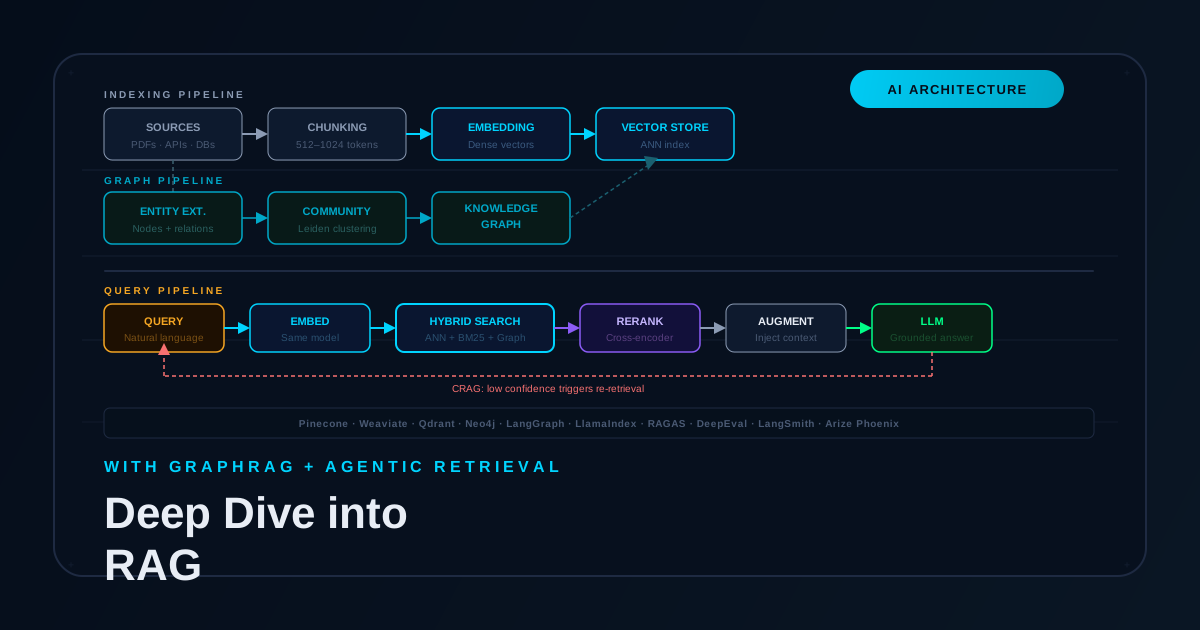
Here’s the full pipeline — offline indexing and graph construction on top, online query path below:
And the online query path, including the CRAG feedback loop:
Search Capabilities: Making Retrieval Actually Smart
The retrieval layer is where most RAG systems succeed or fail. Pure vector search is just the starting point.
Hybrid Search
Pure vector search underperforms on exact terms: product names, error codes, acronyms like “CAPI” or “GitOps,” version numbers. These have no semantic neighborhood — they just are what they are.
Hybrid search combines vector (semantic) search with traditional keyword search (BM25 or TF-IDF) and merges results via Reciprocal Rank Fusion or a tunable alpha parameter. An alpha of 0.7 (70% semantic, 30% keyword) is a reasonable production default for technical documentation.
from langchain.retrievers import EnsembleRetriever
from langchain_community.retrievers import BM25Retriever

hybrid_retriever = EnsembleRetriever(
    retrievers=[vector_retriever, bm25_retriever],
    weights=[0.7, 0.3]
)
Hybrid search consistently outperforms pure vector search in enterprise settings. If you’re running Naive RAG in production today, adding hybrid search is the highest-ROI optimization available.
Metadata Filtering
Vector search doesn’t know about access control, time windows, or organizational structure. Metadata filters apply SQL-like conditions before or during ANN search:
# Only retrieve documents from the Engineering department
# updated after 2025-01-01, visible to this user's clearance level
filters = {
    "department": "Engineering",
    "last_updated": {"$gte": "2025-01-01"},
    "access_level": {"$lte": user.clearance_level}
}
This is non-negotiable in multi-tenant applications, compliance-sensitive environments, or any organization where different roles have different data permissions.
Advanced Techniques
Parent-document retrieval. Index small child chunks (128 tokens) for retrieval precision, return the full parent section (512–1,024 tokens) to the LLM for generation context. Best of both worlds.
Query rewriting. Use a small LLM to transform user queries into retrieval-optimized forms before searching. “What’s our PTO policy?” becomes “employee vacation policy 2026 HR handbook annual leave days.” HyDE (Hypothetical Document Embeddings) takes this further: generate a hypothetical answer to the query, then embed that answer as the search key. Counterintuitive, but it dramatically improves recall on complex questions.
Multi-vector / ColBERT. Rather than one embedding per chunk, ColBERT produces one embedding per token. Matching happens at the token level via MaxSim. Finer-grained than standard dense retrieval, at the cost of higher storage and compute.
Graph Capabilities: The Next Evolution — GraphRAG
Standard RAG handles lookup queries well. It struggles with relational reasoning.
Ask “What does our runbook say about pod eviction?” and RAG finds the answer. Ask “Which of our financial clients have infrastructure in regulated industries, and who are the engineers on those accounts?” and RAG returns semantically similar document chunks — which is not the same as traversing structured relationships across entity types.
GraphRAG, pioneered by Microsoft Research in 2024 and now standard in LlamaIndex 1.x and LangGraph, addresses this by building a knowledge graph alongside the vector store.
How GraphRAG Works
Entity and relation extraction. During offline indexing, every chunk is scanned by an LLM to extract typed entities (Person, Organization, Technology, Concept) and labeled relationships (FOUNDED, REPORTS_TO, USES, DEPLOYED_ON). The results are stored as a graph: nodes with properties, typed edges, and embedding vectors on each node.
from llama_index.core import KnowledgeGraphIndex
from llama_index.graph_stores.neo4j import Neo4jGraphStore

kg_index = KnowledgeGraphIndex.from_documents(
    documents,
    storage_context=StorageContext.from_defaults(graph_store=graph_store),
    max_triplets_per_chunk=10,
    include_embeddings=True,
)
Community detection. Microsoft’s approach runs the Leiden algorithm on the entity graph to identify clusters of tightly related concepts. An LLM generates a plain-language summary of each cluster. At query time, these community summaries answer broad “global” questions — “Summarize our entire competitive positioning” — without scanning thousands of individual chunks.
Query-time traversal. For specific, targeted queries, GraphRAG traverses the graph using Cypher (Neo4j) or GQL, combining path constraints with vector similarity:
MATCH (e:Entity)-[:RELATED_TO*1..3]-(related)
WHERE e.name CONTAINS "RAG"
WITH related,
     vector.similarity.cosine(related.embedding, $query_embedding) AS score
RETURN related ORDER BY score DESC LIMIT 10
The combination of graph traversal (structural constraints) and vector similarity (semantic relevance) produces results that are both topically correct and relationally coherent.
When to Add GraphRAG
Graph construction is expensive — LLM-based entity extraction at scale, plus graph database operational overhead. Reach for it when:
- Queries span multiple documents and require multi-hop reasoning (“who reports to the person who owns this system?”)
- Your domain is inherently relational: org charts, legal entity structures, supply chains, citation networks
- You need explainability — showing the exact graph path the AI followed is a powerful audit trail
- Hallucination on relationship-heavy queries is causing real problems
For simple lookup use cases, hybrid vector search is sufficient and far cheaper.
Advanced RAG Patterns
Agentic RAG
In standard RAG, retrieval is a fixed step. In Agentic RAG, the LLM decides at runtime whether to retrieve, which retrieval strategy to use, whether to call external tools, and whether to iterate. This is implemented via LangGraph state machines or ReAct-style reasoning loops.
Agentic RAG enables multi-step workflows: decompose a complex question into sub-questions, retrieve context for each sub-question independently, synthesize across multiple retrieval steps, and produce a grounded final answer. This is the architecture behind AI systems that feel genuinely intelligent rather than just “fast search.”
Corrective RAG (CRAG)
CRAG adds a verification step after retrieval. A lightweight judge LLM grades each retrieved chunk on a relevance score. Chunks below a threshold (typically 0.6) are discarded. If too few chunks survive, the system falls back to a web search rather than generating with insufficient context.
This is particularly valuable for production systems where retrieval quality degrades over time as the source documents drift — CRAG catches the degradation before it propagates into bad answers.
Self-RAG
Self-RAG fine-tunes the LLM to emit special control tokens mid-generation that trigger retrieval, evaluate retrieved documents, and critique its own output. Produces highly accurate, source-grounded responses. Requires fine-tuning, so it’s not suitable for off-the-shelf deployment — but it’s the direction frontier research is moving.
Multimodal RAG
Text isn’t the only modality worth indexing. Multimodal RAG embeds images (CLIP, SigLIP), audio (Whisper → text), video (frame-level embeddings or transcript-based), and tables (structure-aware chunking) alongside text. As LLMs gain native vision capabilities, the retrieval pipeline extends naturally to heterogeneous document collections.
The 2026 Production Stack
A typical production RAG system in 2026:
| Layer | Component | Common Choices |
|---|---|---|
| Orchestration | Workflow engine | LangGraph, LlamaIndex Workflows |
| Embeddings | Text embedding | Voyage AI, OpenAI, Snowflake-arctic-embed |
| Vector DB | ANN search | Pinecone, Weaviate, Qdrant |
| Graph DB | Knowledge graph | Neo4j AuraDB, Memgraph |
| Reranker | Cross-encoder | Cohere Rerank 3, BGE-Reranker-v2 |
| LLM | Generation | Claude 3.7, GPT-4o, Llama 4 405B |
| Evaluation | Quality metrics | RAGAS, DeepEval, TruLens |
| Observability | Tracing | LangSmith, Arize Phoenix |
Evaluation: Measuring What Matters
A RAG system you can’t measure is a RAG system you can’t improve. The RAGAS framework provides the standard automated metrics:
Faithfulness — does the answer contain only claims supported by the retrieved context? Target: >0.90.
Answer relevance — does the answer address the question that was actually asked? Target: >0.85.
Context precision — are the retrieved chunks relevant to the question? Target: >0.80.
Context recall — does the retrieved context contain all the information needed to answer? Target: >0.75.
Automated metrics are necessary but not sufficient. Build a golden dataset of 100–200 representative queries with human-annotated reference answers. Run automated metrics on every pull request. Run human evaluation quarterly. Monitor for drift: retrieval quality degrades silently as source documents change, and you need to catch it before your users do.
Challenges and Best Practices
Retrieval quality is everything. The LLM can’t generate a grounded answer from irrelevant context. Garbage in, garbage out — but the garbage is invisible because the LLM confidently uses whatever you give it. Invest disproportionately in the retrieval layer.
Latency adds up fast. Query embedding (20–50ms) + ANN search (10–40ms) + re-ranking (100–300ms) + LLM generation (500–1,200ms) = a budget you can blow easily. Stream tokens to the UI, show retrieval results while the LLM is generating, and cache frequent query embeddings.
Knowledge base freshness is a silent failure mode. Stale knowledge produces confidently wrong answers. Implement event-driven incremental indexing: trigger re-indexing via webhooks when source documents change in Confluence, Notion, or your CMS. Store a last_updated timestamp on every chunk so you can deprioritize stale content.
Start simple. The progression that works: Naive RAG → add hybrid search → add re-ranking → add GraphRAG only when multi-hop reasoning is genuinely needed. Don’t over-engineer the first version.
Test adversarially. The queries that break your system are the ones users won’t report — they’ll just stop trusting the product. Probe with out-of-scope questions, questions that presuppose false information, and questions that require reasoning the retrieval pipeline can’t support.
Real-World Impact
Companies operating sophisticated RAG and GraphRAG systems in 2026 consistently report:
- 40–70% reductions in hallucination rates compared to bare LLM deployments
- Significant gains in user trust, particularly in high-stakes domains (legal, financial, clinical)
- Reduced context window costs — graph-structured retrieval surfaces precise, relevant context rather than stuffing large document sections into the prompt
The use cases span every vertical: customer support bots that answer from the latest product docs, legal research assistants that traverse case law and internal memos, financial analysts querying earnings calls and regulatory filings, internal company “second brains” that understand org structure through graph relationships, and scientific research copilots that reason across citation graphs.
Final Thoughts
RAG didn’t just improve AI — it changed what production AI means. By combining semantic vector search with knowledge graph reasoning and intelligent agents, you give models both breadth (massive unstructured knowledge) and depth (structured relational understanding).
The result is AI that is accurate, up-to-date, auditable, and useful at enterprise scale. The winning stack in 2026 isn’t just vectors. It’s vector search + knowledge graphs + intelligent agents. The systems that master this combination are the ones that feel truly intelligent.
Drop your specific use case in the comments — enterprise search, research, customer support — and we’ll sketch a full architecture for you.