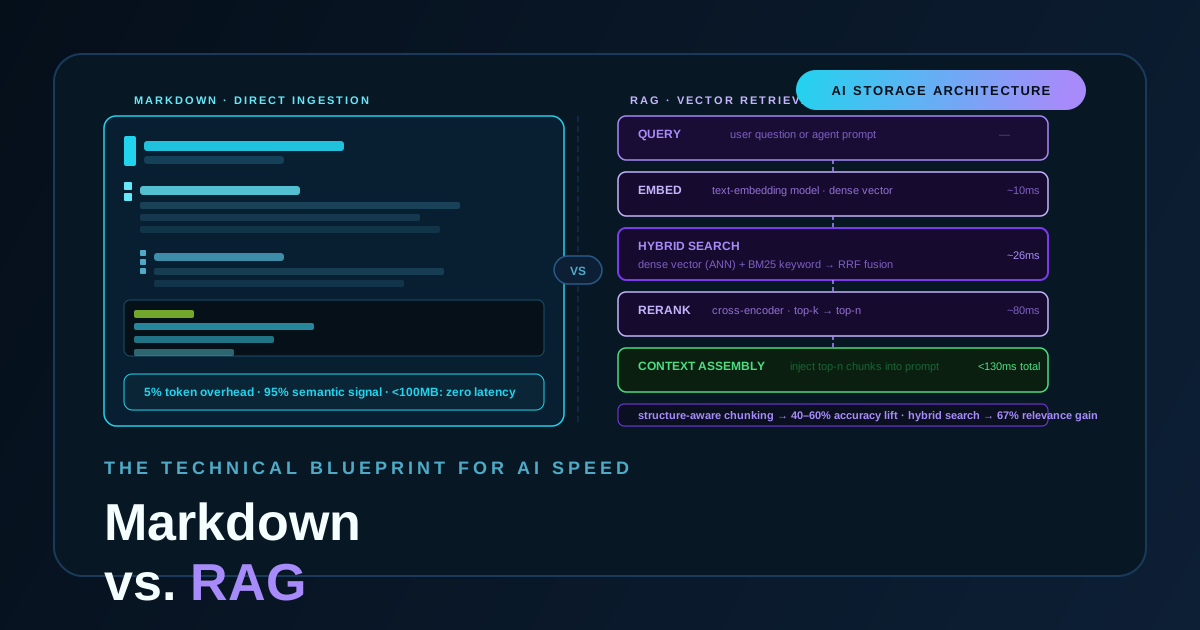
In the race to build high-performance AI infrastructure, the storage format you choose directly shapes your system’s latency, token density, and semantic clarity. For AI engineers and system architects, the choice between raw Markdown storage and Retrieval-Augmented Generation (RAG) isn’t ideological — it’s a pragmatic optimization problem driven by scale, workload, and performance constraints.
The Case for Markdown: Maximum Semantic Signal with Minimal Overhead
Markdown is far more than lightweight plain text. It serves as a clean, structured roadmap that Large Language Models (LLMs) parse efficiently.
Token Efficiency
Markdown delivers approximately 95% of the semantic structure found in HTML while adding only about 5% token overhead from formatting. HTML, by contrast, often burdens the context window with 18% or more boilerplate tags, scripts, and styling noise. Real-world benchmarks show Markdown can reduce token consumption by 20–30% compared to HTML equivalents, lowering API costs and enabling denser, more valuable context within the same window.
Attention Pattern Optimization
Transformer models develop stronger, more reliable attention patterns on consistently structured data. Markdown’s predictable hierarchy (# H1, ## H2, lists, code blocks) helps models focus on semantically important elements. Studies and observations indicate models trained on Markdown-heavy datasets achieve roughly 15% better performance on structured reasoning tasks compared to mixed or noisier formats.
Zero-Latency Retrieval for Small-to-Medium Datasets
For knowledge bases under ~100MB — personal notes, project wikis, small documentation sets — direct Markdown ingestion is unbeatable. You skip the entire “retrieval tax”: no vector database queries, no embedding lookups, no reranking. The model receives the full, unfiltered file immediately. This delivers instant context and eliminates variability introduced by chunking or search approximations.
The Case for RAG: Scalability with Consistent Sub-Second Performance
When your data grows into gigabytes or terabytes, stuffing the entire context hits hard limits on latency, cost, and model comprehension.
Consistent Latency
Modern high-performance RAG pipelines achieve vector search latencies around 30–50ms on optimized vector databases, with full retrieval — including hybrid search and reranking — often completing under 130ms on contemporary hardware. This predictability holds even as your archive scales massively.
Accuracy Lift Through Structure-Aware Chunking
Markdown’s natural headers (H1–H6) enable content-aware chunking, where the system retrieves coherent logical sections rather than arbitrary sentence fragments. This approach can improve retrieval accuracy by 40–60% over naive fixed-size splitting, because chunks align with actual concepts and maintain contextual integrity.
Hybrid Search Advantage
Markdown files pair perfectly with both semantic embeddings and classical keyword methods like BM25. Hybrid retrieval — combining dense vector similarity with sparse exact-term matching — delivers significantly more accurate results, often in the 40–60%+ improvement range for relevance in mixed query scenarios. This fusion captures both “meaning” and precise terminology that pure vector search might miss.
Comparison at a Glance
| Markdown (Direct) | RAG (Vector + Hybrid) | |
|---|---|---|
| Best for | Personal notes, small wikis, projects < 100MB | Enterprise knowledge bases, massive or dynamic datasets |
| Speed | Instant for small data; degrades sharply with overload | Consistent sub-second retrieval (often <130ms total) at scale |
| Accuracy | High — model sees complete, unfiltered files | Variable but tunable; strong with good chunking and hybrid search |
| Setup | Minimal — save as .md and load | Higher — requires embeddings, vector DB, chunking strategy |
| Token efficiency | Excellent (low overhead, high signal) | Good, but depends on retrieved chunk quality |
| Debuggability | Trivial — grep, Git diffs | Requires tracing retrieval paths |
The Hybrid Strategy: Markdown as the Source of Truth
The most robust production architectures treat Markdown as the canonical source while layering RAG on top for scale.
Why This Wins
Debuggability. When the AI hallucinates or errs, you can instantly search your raw Markdown files with tools like grep or ripgrep to audit the underlying data. No opaque vector indices to reverse-engineer.
Version control and auditability. Store your “AI memory” in plain Markdown files under Git. Track every change to knowledge with full history, branches, and diffs — something binary vector stores or databases make cumbersome or impossible.
Seamless transition. Start simple with direct Markdown loading for small sets. As data grows, add indexing and RAG without rewriting your content. Markdown’s structure makes chunking, metadata extraction, and hybrid search far more effective.
In practice, many advanced systems index Markdown files directly for both BM25 keyword search and vector embeddings, preserving the format’s strengths while gaining scalability.
Final Takeaway for AI Architects
Choose Markdown-first when you can. It maximizes semantic density, minimizes latency and cost for moderate scales, and keeps your system transparent and maintainable.
Layer on RAG (especially hybrid) when scale demands it. It provides predictable performance and handles massive, dynamic knowledge without overwhelming context windows.
The winning blueprint isn’t Markdown or RAG — it’s Markdown as the source of truth, with high-quality RAG as the scalable retrieval layer.
This combination delivers the best of both worlds: clean, efficient data representation for LLMs and engineered retrieval that scales without sacrificing clarity or debuggability. Implement this thoughtfully, measure your specific latency/accuracy/cost tradeoffs, and iterate. In AI infrastructure, the format you choose today determines how fast — and how reliably — your systems will run tomorrow.