Everyone’s talking about AI agents. Most implementations are expensive chatbots with a marketing label.
The term gets applied to everything from a ChatGPT thread with a button to systems that autonomously manage deployments and customer operations. That imprecision isn’t just annoying — it directly shapes the architectures you choose, the failure modes you inherit, and whether your “agent” actually ships value or becomes a production liability.
Let’s fix that.
The Operational Definition
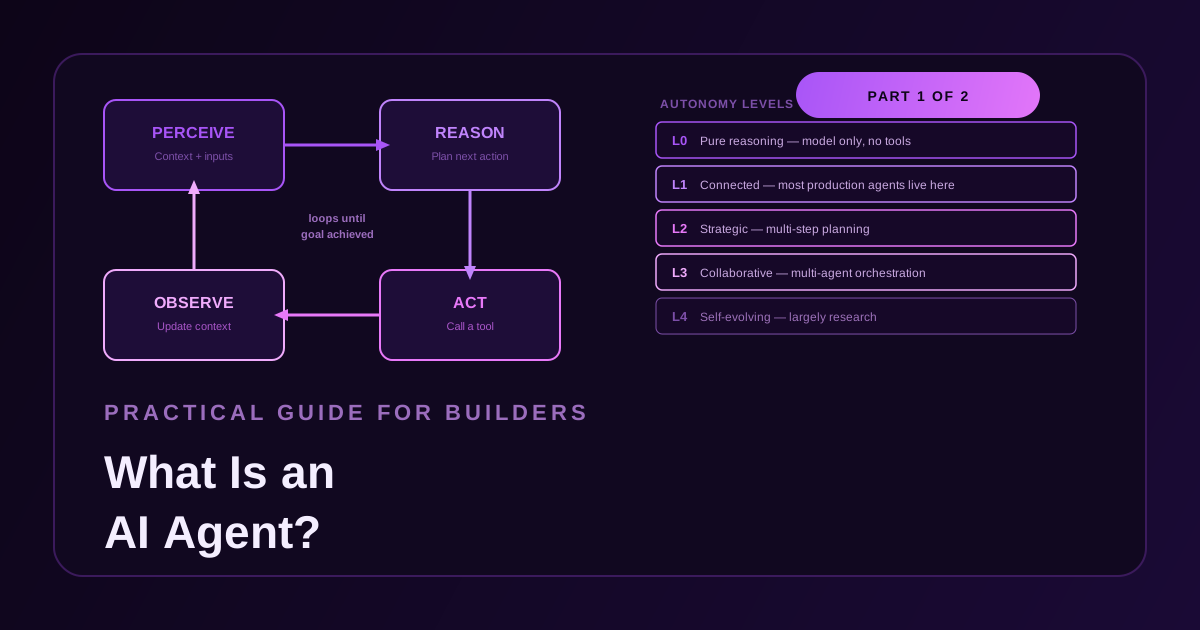
An AI agent is an application that places a language model in a continuous loop: it perceives its environment through inputs and context, reasons about the next action, executes that action via tools, observes the result, and iterates — until the goal is achieved or a stopping condition fires.
Shorter: a language model in a loop, augmented with tools, to accomplish an objective.
This think-act-observe cycle is what separates agents from static inference. The loop introduces probabilistic control flow, which is simultaneously the source of power and the root of every 2 a.m. incident. Understanding that trade-off in detail is the entire discipline.
┌───────────┐     ┌───────────┐     ┌───────────┐     ┌───────────┐
│  Perceive │────▶│  Reason   │────▶│    Act    │────▶│  Observe  │
│           │     │           │     │           │     │           │
│ Context + │     │ Plan next │     │ Call a    │     │ Update    │
│ inputs    │     │ action    │     │ tool      │     │ context   │
└───────────┘     └───────────┘     └───────────┘     └─────┬─────┘
      ▲                                                      │
      └──────────────────────────────────────────────────────┘
                     loops until goal is achieved
The Four Components
Every agent is built from the same four parts. Three get the attention. One determines whether it survives production.
The Model — the reasoning engine. The LLM analyzes context and decides what to do next. It never executes actions directly; it only plans them. Its output quality is entirely bounded by the quality of the context you feed it. Weak context produces confident stupidity.
Tools — the interface to the real world. APIs, functions, databases, external services. Tools let the agent fetch live data, run computations, and take real-world actions. Without them, you have expensive autocomplete, not an agent.
The Orchestration Layer — the nervous system. This owns the loop: planning, state tracking, memory retrieval, tool dispatch, error recovery, and termination logic. Orchestration is what converts isolated model calls into coherent, goal-directed behavior. Most production failures originate here, not in the model.
Runtime and Deployment Services — what separates prototypes from production. Monitoring, logging, security, human-in-the-loop approvals, and observability. Skipping this layer is the most common reason capable demos become unreliable systems.
┌─────────────────────────────────────────────┐
│               Agent session                 │
│                                             │
│   ┌─────────────┐      ┌─────────────────┐  │
│   │    Model    │◀────▶│  Orchestration  │  │
│   │  (reasons)  │      │  (owns the loop)│  │
│   └─────────────┘      └────────┬────────┘  │
│                                 │           │
│   ┌─────────────────────────────▼─────────┐ │
│   │                Tools                  │ │
│   │   APIs · functions · databases · RAG  │ │
│   └───────────────────────────────────────┘ │
└─────────────────────────────────────────────┘
                     │
       ┌─────────────▼─────────────┐
       │    Runtime & deployment   │
       │  observability · guardrails│
       │  logging · human-in-loop  │
       └───────────────────────────┘
Chatbot, Copilot, Agent: Different Architectures, Not a Capability Ladder
These aren’t points on a spectrum — they’re fundamentally different system designs with different failure modes and operational contracts.
┌─────────────┬──────────────┬──────────────┬──────────────────────────────┐
│             │   Chatbot    │   Copilot    │           Agent              │
├─────────────┼──────────────┼──────────────┼──────────────────────────────┤
│ State       │ Stateless    │Session-scoped│ Persistent                   │
│ Tools       │ None         │ Suggests     │ Executes                     │
│ Autonomy    │ Reactive     │ Assistive    │ Goal-directed                │
│ Fails via   │Hallucination │Bad suggestion│ Unexpected cascading action  │
│ Who catches │ You review   │ You act on   │ Nobody, unless you built     │
│ failures    │ output       │ output       │ the guardrails               │
└─────────────┴──────────────┴──────────────┴──────────────────────────────┘
The failure mode column is what matters. Agents introduce a new risk class: autonomous actions with real consequences — financial, legal, reputational. Design your system around its actual failure modes, not the ones you hope it avoids. Audit logs, guardrails, and rollback mechanisms aren’t polish — they’re load-bearing.
The Autonomy Spectrum
Not every agent needs maximum autonomy. Matching autonomy level to the task is one of the most underrated architectural decisions.
Level 0 — Pure reasoning
  Model only. No tools, no state.
  Capable for analytical tasks where all needed context fits in the prompt.
  │
Level 1 — Connected
  Model + tools for data fetching and simple actions.
  Where most production agents actually live today.
  Most should stay here.
  │
Level 2 — Strategic
  Multi-step planning with cross-iteration context maintenance.
  The model reasons about sequences, not just immediate next steps.
  Context degradation becomes a real risk.
  │
Level 3 — Collaborative
  Multiple specialized agents coordinated by an orchestrator.
  Coordination overhead rises sharply.
  Communication failures become the new bottleneck.
  │
Level 4 — Self-evolving
  The system modifies its own tools, prompts, or behavior.
  Still largely research or heavily guarded production.
  Requires sandboxing and mandatory human oversight.
Most teams ship Level 1 while targeting Level 2. That gap is where reliability dies.
The rule: start at the lowest level that solves the problem. Only move up when reliability is proven and the use case genuinely demands it. Higher levels add coordination complexity faster than they add value.
How Your Job Changes as a Builder
Traditional software development is deterministic — you code every path explicitly. Agent development is closer to directing a capable but non-deterministic system: you define the goal, equip it with tools, craft the system prompt, and shape behavior through context at each iteration.
Control flow becomes probabilistic. The instinct is to compensate with endless conditionals and guardrails — but often that means fighting the architecture rather than leveraging it.
Your highest-leverage skill shifts from writing logic to context engineering: the deliberate assembly of what goes into the model’s context window at each iteration. Every token costs latency, money, and signal quality. The model’s reasoning quality is bounded entirely by the quality of this assembly.
Expect to spend more time on observability and failure recovery than on the happy path. The happy path in an agent is a minority of real sessions.
The Questions to Ask Before You Build
Skip “Is this an agent?” Ask: what level of autonomy does this task actually require?
Before writing any orchestration code:
┌─────────────────────────────────────────────────────────────────────┐
│  Pre-build checklist                                                │
├─────────────────────────────────────────────────────────────────────┤
│  What specific decisions or actions will the system make           │
│  autonomously?                                                      │
│                                                                     │
│  What are the failure consequences, and what does recovery         │
│  look like?                                                         │
│                                                                     │
│  What triggers each loop iteration?                                │
│                                                                     │
│  What tools can it call, and what real-world impact can            │
│  those calls have?                                                  │
│                                                                     │
│  Are actions auto-executed or human-approved?                      │
│                                                                     │
│  How is failure detected, logged, and recovered?                   │
│  What audit trail exists?                                           │
│                                                                     │
│  What is the blast radius if a single session goes wrong?          │
└─────────────────────────────────────────────────────────────────────┘
Vague answers mean prototype. Production agents are observable, auditable, and recoverable by design — not as an afterthought.
What’s Next
The definition, components, and autonomy model give you the mental framework. The harder questions are about the plumbing: how memory is designed, how tools are built to fail gracefully, how orchestration patterns differ and when to use each, how multi-agent systems coordinate without producing race conditions, and how observability is instrumented so you can debug a session after the fact.
That’s what Part 2 covers.